

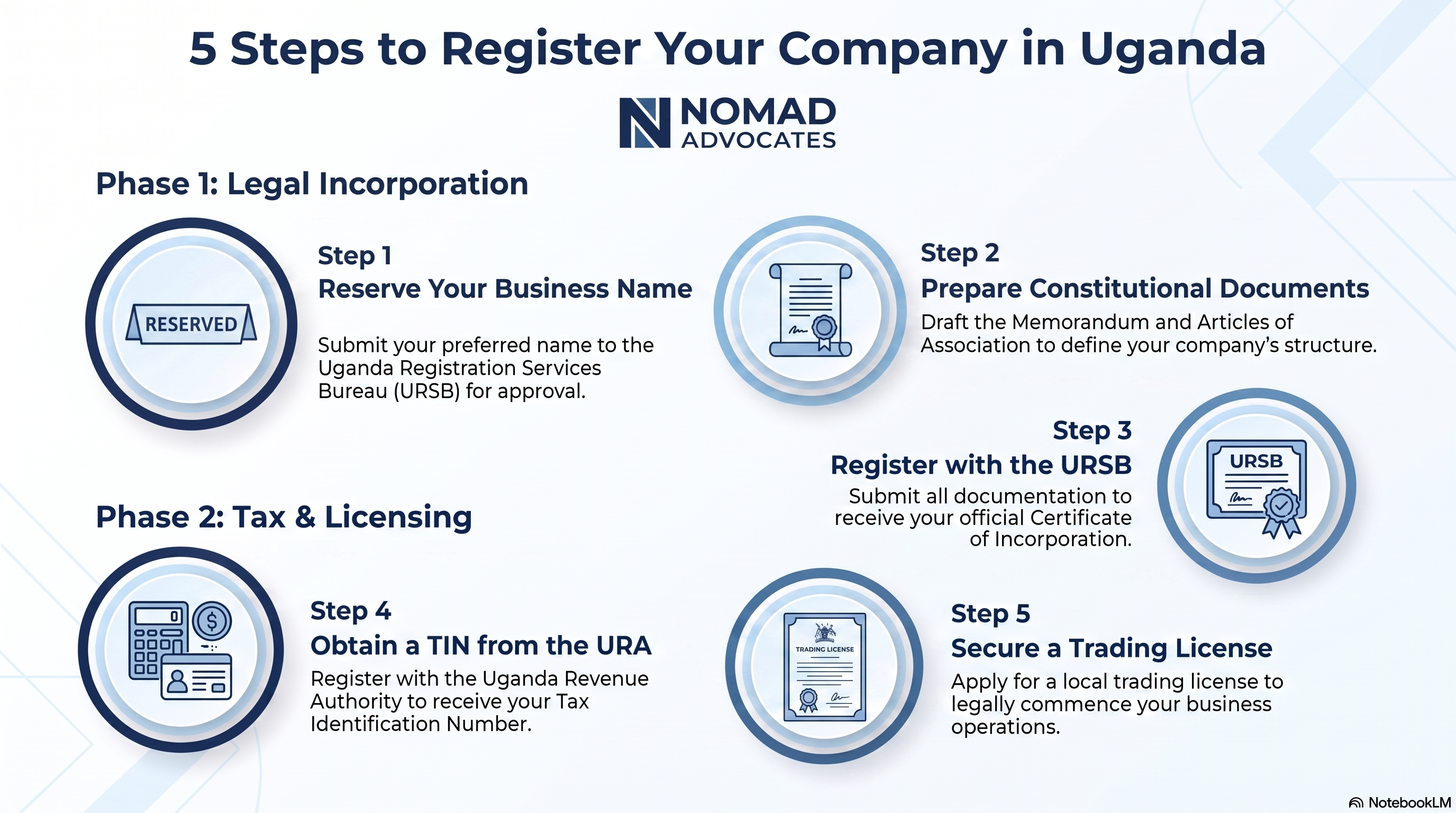
HOW TO REGISTER A COMPANY IN UGANDA
Starting with the right legal foundation
Registering a company is more than obtaining a certificate of incorporation. It creates a separate legal person that can own property, enter contracts, employ staff, borrow money and continue despite changes in its shareholders or directors. That protection is valuable, but it comes with duties: the company must maintain accurate records, disclose its controllers, file required returns and ensure that people acting for it have proper authority.
The most common vehicle for a private business is a private company limited by shares. It is usually suitable where the founders intend to trade for profit, divide ownership through shares and limit personal exposure to the amount unpaid on those shares. Other structures may be better for a sole trader, professional partnership, charitable activity, joint venture or a group establishing a Ugandan subsidiary. The structure should therefore follow the business plan rather than convenience alone.
Uganda Registration Services Bureau (URSB) administers company incorporation. The process is substantially electronic, but legal accuracy still matters. Problems often begin with unclear shareholding, copied articles of association, nominee arrangements that are not documented, or forms filed without the genuine authority of directors and subscribers. Correcting these defects later can be slower and more expensive than preparing the incorporation properly.
The legal and governance questions to resolve
Company type and objects
The Companies Act permits several forms of company, including private companies limited by shares, companies limited by guarantee, public companies and single member companies. The intended ownership, fundraising model, liability profile and regulatory sector determine the appropriate form. Although modern companies may have broad capacity, regulated activities still require sector licences and the company’s constitutional documents should support its real business.
Name, registered office and identity
A proposed name should not be identical, misleading or unlawfully suggestive of government connection. The company must have a registered office and reliable contact details in Uganda. Founders should also ensure that names, national identification numbers, passport details and dates of birth are entered consistently, because discrepancies can obstruct banking, tax, immigration and future share-transfer processes.
Share capital and ownership
The subscribers must decide the number and class of shares, the rights attached to them and the initial allotment. Equal shareholding can create deadlock where there is no tie-breaking mechanism. Where one founder contributes cash and another contributes intellectual property, equipment or work, the valuation and vesting terms should be documented rather than left to assumptions.
Directors, secretary and authority
Directors manage the company and owe duties to act for proper purposes, exercise care and avoid misuse of company property or information. The incorporation documents should identify the first directors and any secretary required by law or chosen by the company. Internal signing rules, bank mandates and delegated authority should then be approved through proper resolutions.
Beneficial ownership
The register is concerned not only with the names appearing as shareholders but also with natural persons who ultimately own or control the company. Beneficial ownership particulars must be filed and maintained in accordance with the Companies Act and the Companies (Beneficial Owners) Regulations. Informal nominee arrangements do not remove disclosure obligations and may create serious compliance risk.
About the author
NOMAD Advocates assists local and foreign founders with company formation, governance documents, beneficial ownership, investment structuring, licences and ongoing corporate secretarial compliance. Early advice helps prevent ownership disputes and makes the business easier to bank, finance, sell or pass to the next generation.
www.nadvocates.com or info@nadvocates.com
Disclaimer: This article is prepared for general public information. It does not replace legal advice on the facts of a particular matter. Laws, fees, forms and administrative practice may change, and professional advice should be obtained before taking or delaying legal action.